





Business formation & legal
Build your business on a solid foundation

Your guide to business formation structures
Deciding whether you should go through the business formation process does not have to be stressful when you know what to expect. This includes knowing the structure options like LLC, S corp, C corp, nonprofit, and PLLC, as well as having a good idea of your future plans. As your business grows, shrinks, or your plans change, you can modify the structure. You may start as a C corp and later decide that being an S corp is better for tax reasons because you want to be a pass-through entity. When this happens, you may only need to file an IRS Form 2553 to make the change. That’s what this guide is all about: helping you understand your options so that you can make informed decisions.
While a professional business structure like an LLC is not required by all lenders to get a small business loan or business credit card, EINs are required with very few exceptions. Having a structured entity also makes your company look more professional as it can be looked up in your Secretary of State’s website.
Below you’ll find information we’ve compiled on business formation and how to navigate the early stages of your company.

What is business structure formation?
A business formation or structure is when you establish your business as an entity with the state you operate in and the federal government. You do this by choosing one of the following designations or entity types:
- LLC: A limited liability company formation helps to limit third-party access to your personal assets as they become separate from the business entity and business assets.
- PLLC: Professional limited liability company is similar to a standard LLC but is for licensed professionals like doctors, CPAs, and lawyers. This structure has additional state requirements and restrictions.
- S corp: Subchapter S corporation allows a small business to operate as a pass-through company, meaning profits, losses, deductions, and credits can be taxed on personal taxes versus needing to be on the business’s taxes.
- C corp: Subchapter C corporations are standard business incorporations where the profits, losses, deductions, and credits are taxed on the business and not on the owner’s personal taxes.
- Nonprofit: This is a type of business entity/organization designed to benefit the public through social causes (like religious institutions and schools). It is not a for-profit business.
Each type of business entity comes with different rules on taxes. Some formations may be more beneficial when it comes to protecting personal assets in the case of a lawsuit, debts being owed, and other business problems. Each state and the federal government will have different regulations for each type, and these can change at any point in time, so it is best to look at your secretary of state’s website at least quarterly for updated rules, protections, and regulations.
Note: In some instances, protections can be overturned via “piercing the corporate veil”, so they are not a foolproof way to protect your business.

Benefits of using business formation services
There are pros and cons to doing your own business formation or using an online service. It comes down to your priorities, whether you want to save money or have peace of mind that everything is done correctly.
Forming on your own:
- Saves you money as you won’t have to pay any fees.
- Lets you form on your own schedule, making it flexible.
Using a reputable formation service offers you:
- Assurance that all paperwork, including articles of incorporation, DBAs, and license research, is done correctly.
- An experienced set of eyes reviewing your documentation before you submit to the state.
- Documents and services you may not have thought of, including registered agent services and virtual addresses for privacy.
- Optional add-ons for services including getting an EIN number, registering a foreign qualification, or securing trademarks and service marks.
- Legal advice from lawyers in your state or financial advice from advisors and CPAs located in your state.
- Time savings, as the legwork and guesswork will be taken care of.
Find out which of our trusted partners is the best fit for your business. Click here to get matched with your top options in seconds.

Six types of business organizations and entities
We’ve already gone over some of the unique elements in each of the six types of business formations and entities. In this next section, we’ll do a quick breakdown of the four most commonly selected structures, including their advantages and disadvantages.
Sole proprietorship
Owned and operated by one person, this is the simplest business structure.
Ownership: There is a single owner.
Liability: Unlimited personal liability; the owner is personally responsible for business debts.
Taxation: Income is reported on the owner’s personal tax return (pass-through taxation).
Advantages: This type of business is low-cost and simple to set up, and the owner has full control.
Disadvantages: With only a single owner, it is harder to raise capital, and personal liability is high.
Limited liability company (LLC)
This is a hybrid entity that offers the limited liability of a corporation with the tax benefits of a partnership or sole proprietorship.
Ownership: This type of business is owned by multiple members (individuals, corporations, or other LLCs).
Liability: Limited liability; members are not personally liable for business debts.
Taxation: LLC owners can elect to be taxed as a corporation, or they can take advantage of pass-through taxation and pay personal income taxes for their share of the business.
Advantages: There is limited liability for owners, flexible management options, and pass-through taxation.
Disadvantages: This type of business is more complex to set up than a sole proprietorship, and there are various state regulations that must be followed.
S corporation (S corp)
This is a corporation that passes taxes, income, etc. at the shareholder level rather than the corporate level.
Ownership: This is capped at 100 shareholders, all of whom must be U.S. citizens or residents.
Liability: There is limited liability for shareholders.
Taxation: Pass-through taxation; profits are taxed at the shareholder level, not the corporate level.
Advantages: These include limited liability, pass-through taxation, and no corporate taxes.
Disadvantages: There are strict eligibility requirements (i.e., the number and type of shareholders), more paperwork for registration, and more regulations to follow.
C corporation (C corp)
This is a standard corporation where the business is a separate legal entity from its owners.
Ownership: There can be an unlimited number of shareholders.
Liability: There is limited liability for shareholders.
Taxation: Double taxation; profits are taxed at both the corporate level and again at the shareholder level when distributed as dividends.
Advantages: There is limited liability, it’s generally easier to raise capital, and the company can issue stock.
Disadvantages: There is double taxation, there are more complex regulations, and it requires detailed record-keeping.

How to choose the right structure for your business
The business structure you choose today can be changed as your company and needs evolve, so don’t stress if you select one now but are worried that you may want to change in the future. Focus on your current and near future situation, then ask yourself these questions to make the right decision.
- Is having control over business decisions important to me?
What level of liability am I comfortable with? - Would I prefer to split responsibility with another person or several other owners?
- Am I prepared to raise capital for my business if it’s needed?
- Do I want a pass-through business for my finances, or am I ok with being taxed through my business?
- Do I plan on offering equity and taking on investors in the near future?
- Am I ok with a bit more paperwork?
Based on your answers, you can review the breakdown above and see which option is most aligned with your vision. From there, you may want to seek counsel to better understand which structure best supports your goals.

See your top options in seconds
Where do I go to form my company as an entity?
There are generally three options you can use to form your business entity:
- The secretary of state’s website
- Your accountant
- An online formations company
To form your company entity or business structure, go to your secretary of state’s website and search for “register my business” if you don’t see a link from the homepage. You can also do a search on Google or Bing for “Register my company in (insert your state).” If you don’t want to do it on your own and you have an accountant or CPA you trust, they’ll likely be familiar with this and may be able to do it for you.
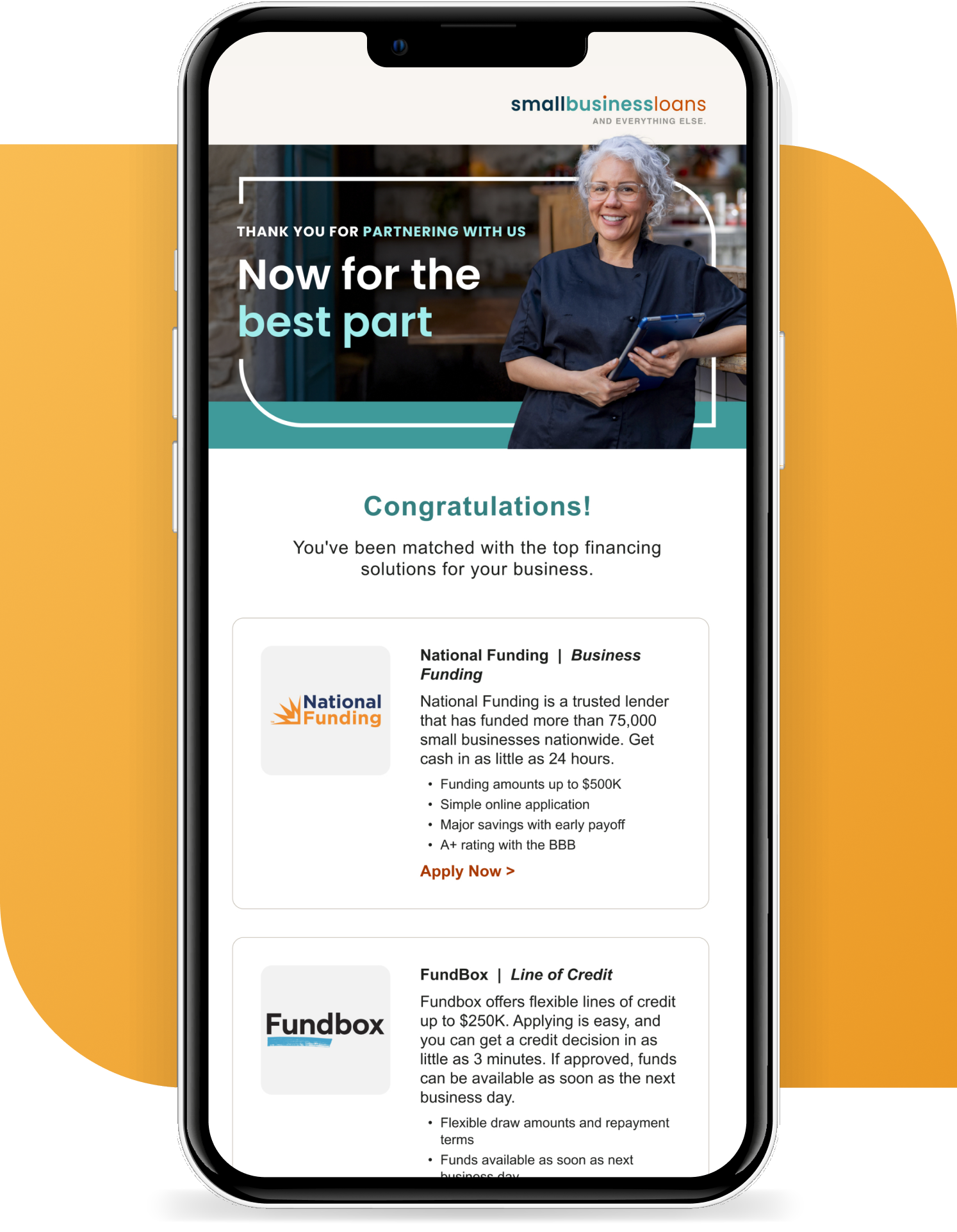
The other option is to use one of the online business formation companies. Each has unique selling points and additional services available for your consideration. Want to save time and still find the best solution for your business? Click here to get matched with the top options for your profile. It only takes seconds.
Why America’s
SMBs love using SBL
The SmallBusinessLoans marketplace was built to serve small and medium-sized businesses (SMBs). Here’s how our platform sets you up for success.


Tailored solutions: We only match you with products and services that cater to your unique needs and profile.


Trusted partners: All of our partners go through an extensive vetting process, so you can move forward with confidence.


Free service: See all the best solutions for your business without any cost or commitment. It only takes seconds!
